I currently use a Behringer MDX1600 processor/compressor in my (admittedly limited) audio chain. It's the last item before the isolation transformer that connects to the ACC2 port on my SDX. I noticed something early on that kind of bugged me about it -- it's less of an issue now, but I've become curious if I'm the only one that's seen/heard it.
I found that if I was using the downward expander and had the "interactive knee" control enabled, I would sometimes hear clicking/popping in the audio. I noticed that this clicking/popping apparently corresponded to some of the LEDs on the front panel flickering on and off, particularly, it seemed, the indicator LEDs above the compression threshold control. Depending on how things are set up, those LEDs may not trigger as often, which makes the problem less noticeable. Nobody's ever noticed it on the air, but I when it happened I could hear it in the monitor. (And of course, we're all picky about our the cleanliness of our voodoo.)
I may not be using this processor much longer (I had a holiday "rack attack" and ordered some new toys which may make it redundant), but I know others use this same unit and yet I've never seen anybody mention having the same experience. This made me wonder if there was just something fishy with my particular unit/installation or if was doing something wrong.
-Bill, N1GPT
Behringer MDX1600 question
I've never owned a '1600--only use the '1400. With the MDX1400 I use here, it does NOT display that anomaly. I'm believing there is an obvious redesign to the '1600, so I wouldn't necessarily encounter the same thing on my end. In fact I just tested it on the 1400 and nothing at all. Even tried replicating it by increasing the input signal and readjusting for more expansion and still no replication to that particular issue you're encountering, BP.
Hope there is a solution for this. [Very curious to the cause and remedy]

Grats on the new processors incoming--hope we get a list and photos of the latest additionals.
Hope there is a solution for this. [Very curious to the cause and remedy]
Grats on the new processors incoming--hope we get a list and photos of the latest additionals.
Well, like I said, nobody ever remarked about it on the air, but I thought I'd ask. But I've now taken the MDX1600 out of line and the new gear has no such problems.
The old configuration I had was:
Behringer B1 mic
Xenyx 502 mixer
Nady 31-band EQ
MDX1600
Radial Engineering J-ISO isolation transformer
TS-950SDX (via ACC2 port)
The new configuration is:
Behringer B1 mic
MIC2200 pre-amp
DEQ2496
FX2000 Virtualizer 3D
Radial Engineering J-ISO isolation transformer
TS-950SDX (via ACC2 port)
Getting things set up right took a while, but it was worth it. The only problem I ran into was a ground loop hum when I got rid of the Xenyx 502 mixer and replaced it with the MIC2200 pre-amp. The 502 has a 2-pin AC plug and the MIC2200 has a 3-pin one. I've learned that since I already have a separate ground on the rig, having anything in the audio chain connected to the AC electrical ground will just create an AC hum. Normally I would just get one of those adapters that lets you plug a 3-pin AC plug into a older 2-pin outlet, but I didn't have one handy, so instead I found a spare 3-pin cable and just removed the ground pin with a pair of pliers. This sounds insane, but it worked: as soon as I swapped AC cables, the hum went away completely.
Another nice thing is that where the 502 mixer had only a balanced output (forcing me to have a balanced connection to the EQ), everything is now hooked up using balanced XLR cables. Previously I had occasional issues with RF feedback on 40 meters that led me to add ferrite chokes to the balanced connections and ground wires to all the audio gear. Now there's no RF feedback on 40 even with all the ground wires removed.
The only minor configuration annoyance I ran into was that the DEQ2496's dynamics module will only let you do compression or downward expansion, but not both. I wanted a little of each. Luckily, if you select dual mono mode, you can set each channel independently, so I hooked both channels up in series and used the EQ and compressor on one channel and the downward expander on the other.
Oh yeah: being able to save and recall presets is wonderful for tweaking. I don't know how I managed without it before.
I'll see about getting pictures up eventually.
-Bill, N1GPT
The old configuration I had was:
Behringer B1 mic
Xenyx 502 mixer
Nady 31-band EQ
MDX1600
Radial Engineering J-ISO isolation transformer
TS-950SDX (via ACC2 port)
The new configuration is:
Behringer B1 mic
MIC2200 pre-amp
DEQ2496
FX2000 Virtualizer 3D
Radial Engineering J-ISO isolation transformer
TS-950SDX (via ACC2 port)
Getting things set up right took a while, but it was worth it. The only problem I ran into was a ground loop hum when I got rid of the Xenyx 502 mixer and replaced it with the MIC2200 pre-amp. The 502 has a 2-pin AC plug and the MIC2200 has a 3-pin one. I've learned that since I already have a separate ground on the rig, having anything in the audio chain connected to the AC electrical ground will just create an AC hum. Normally I would just get one of those adapters that lets you plug a 3-pin AC plug into a older 2-pin outlet, but I didn't have one handy, so instead I found a spare 3-pin cable and just removed the ground pin with a pair of pliers. This sounds insane, but it worked: as soon as I swapped AC cables, the hum went away completely.
Another nice thing is that where the 502 mixer had only a balanced output (forcing me to have a balanced connection to the EQ), everything is now hooked up using balanced XLR cables. Previously I had occasional issues with RF feedback on 40 meters that led me to add ferrite chokes to the balanced connections and ground wires to all the audio gear. Now there's no RF feedback on 40 even with all the ground wires removed.
The only minor configuration annoyance I ran into was that the DEQ2496's dynamics module will only let you do compression or downward expansion, but not both. I wanted a little of each. Luckily, if you select dual mono mode, you can set each channel independently, so I hooked both channels up in series and used the EQ and compressor on one channel and the downward expander on the other.
Oh yeah: being able to save and recall presets is wonderful for tweaking. I don't know how I managed without it before.
I'll see about getting pictures up eventually.
-Bill, N1GPT
Okay, I promised a photo of the new setup, so here you go:
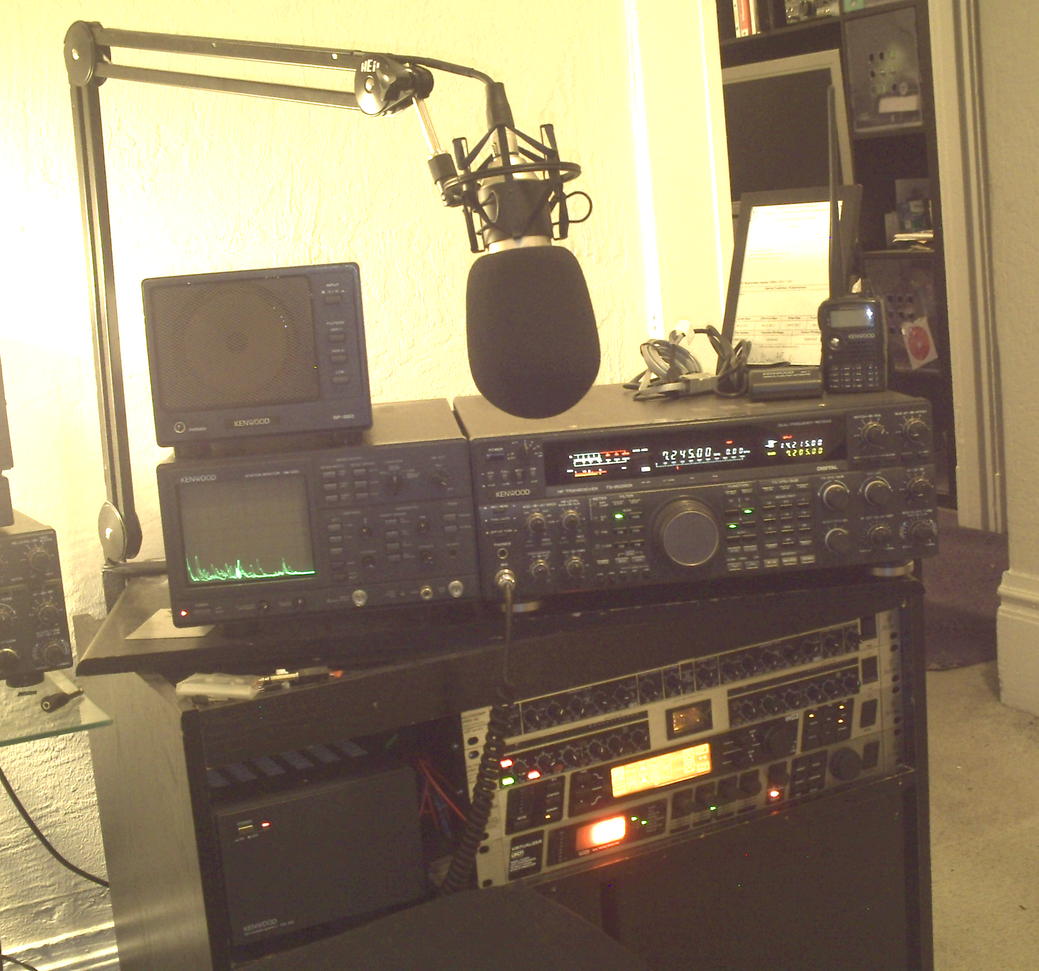
The station includes:
Kenwood TS-950SDX (voodoo modified by me, with AM firmware)
Kenwood SM-230 station monitor
Kenwood SP-950 speaker
Kenwood MC-43S hand mic (used as a hand switch)
(I just got the SP-950 recently; finally I have the whole set. )
)
Behringer B1 mic
Behringer MIC2200 preamp
Behringer DEQ2496 eq/processor
Behringer FX2000 effects processor
Radial Engineering J-ISO isolation transformer (not visible, behind the radio, feeds into the ACC2 port)
Here's a brief audio clip demonstrating the setup:
http://people.freebsd.org/~wpaul/station/short.mp3
This was made using the TS-950SDX transmitting in AM mode, using my TS-850SAT as the receiver. All three examples are done with the DSP lo and hi cut set to 'off,' and illustrate:
- MC-43S hand mic from the front panel
- Behringer mic from the ACC2 port, with only the compressor and downward expander enabled
- Behringer mic with the EQ and effects processor enabled
Again, this an AM mode recording, not eSSB, but it sounds just as good either way.
-Bill, N1GPT
The station includes:
Kenwood TS-950SDX (voodoo modified by me, with AM firmware)
Kenwood SM-230 station monitor
Kenwood SP-950 speaker
Kenwood MC-43S hand mic (used as a hand switch)
(I just got the SP-950 recently; finally I have the whole set.
)Behringer B1 mic
Behringer MIC2200 preamp
Behringer DEQ2496 eq/processor
Behringer FX2000 effects processor
Radial Engineering J-ISO isolation transformer (not visible, behind the radio, feeds into the ACC2 port)
Here's a brief audio clip demonstrating the setup:
http://people.freebsd.org/~wpaul/station/short.mp3
This was made using the TS-950SDX transmitting in AM mode, using my TS-850SAT as the receiver. All three examples are done with the DSP lo and hi cut set to 'off,' and illustrate:
- MC-43S hand mic from the front panel
- Behringer mic from the ACC2 port, with only the compressor and downward expander enabled
- Behringer mic with the EQ and effects processor enabled
Again, this an AM mode recording, not eSSB, but it sounds just as good either way.
-Bill, N1GPT
Very niiiiiice. Happy you made the comparisons for us to hear--it's always a great thing to follow "a painting in progress". I still wanna hear an eSSB recording (with all THREE examples).
As for "lifting" the ground on audio gear, it's a common practice. I had to do it with my DJ rigs and home theater systems as far back as I can remember. We just happen to have a bunch of those adapters, so breaking off the ground pin was not necessary.
As for "lifting" the ground on audio gear, it's a common practice. I had to do it with my DJ rigs and home theater systems as far back as I can remember. We just happen to have a bunch of those adapters, so breaking off the ground pin was not necessary.
Well, since you asked, here's another recording made in SSB mode. This was recorded using the monitor on the TS-950SDX, in LSB mode, with the power control turned all the way down.
http://people.freebsd.org/~wpaul/station/ssb3mics.mp3
There are 5 samples:
- Kenwood MC-43S hand mic through the front panel
- Kenwood MC-60A desk mic through the front panel (I had it around, thought I'd give it a try)
- Behringer mic through the ACC2 port, unequalized (but with compression and downward expansion)
- Behringer mic with equalization
- Behringer mic with equalization plus an added mid-range boost
The DEQ2496 is the main component at work here. I'm using the graphic EQ, dynamic EQ and dynamics (compressor/expander) modules. I have it set for dual mono mode, with both channels in series.
-Bill, N1GPT
http://people.freebsd.org/~wpaul/station/ssb3mics.mp3
There are 5 samples:
- Kenwood MC-43S hand mic through the front panel
- Kenwood MC-60A desk mic through the front panel (I had it around, thought I'd give it a try)
- Behringer mic through the ACC2 port, unequalized (but with compression and downward expansion)
- Behringer mic with equalization
- Behringer mic with equalization plus an added mid-range boost
The DEQ2496 is the main component at work here. I'm using the graphic EQ, dynamic EQ and dynamics (compressor/expander) modules. I have it set for dual mono mode, with both channels in series.
-Bill, N1GPT